The classic chore chart sounds like a great idea.
You make a list. You add names. You put it on the fridge. Everyone agrees that this time, the system will work.
Then real life happens.
The chart is forgotten. Someone completes a chore but no one marks it. Another child says the list is unfair. A parent forgets to update it. The stickers disappear. After a week, the chore chart becomes background decoration.
The problem is not that families do not need structure. They do.
The problem is that most chore charts are too static for actual family life.
Why paper chore charts fail
Paper chore charts fail for three simple reasons.
First, they are easy to ignore. A chart on the wall only works if children remember to look at it and parents remember to update it.
Second, they do not fit flexible family life. Some days are busy. Some tasks change. One child may be home while another is at practice. A paper chart does not adapt easily.
Third, they often create more work for the parent. Someone still has to remind, check, approve, mark and reset the chart. When the parent becomes the engine behind the entire system, the chart has not really reduced mental load.
It has just moved it onto the fridge.
Want calmer days like this? Start with OurFamilyHub — it’s free.
Download on the App StoreKids need visibility, feedback and celebration
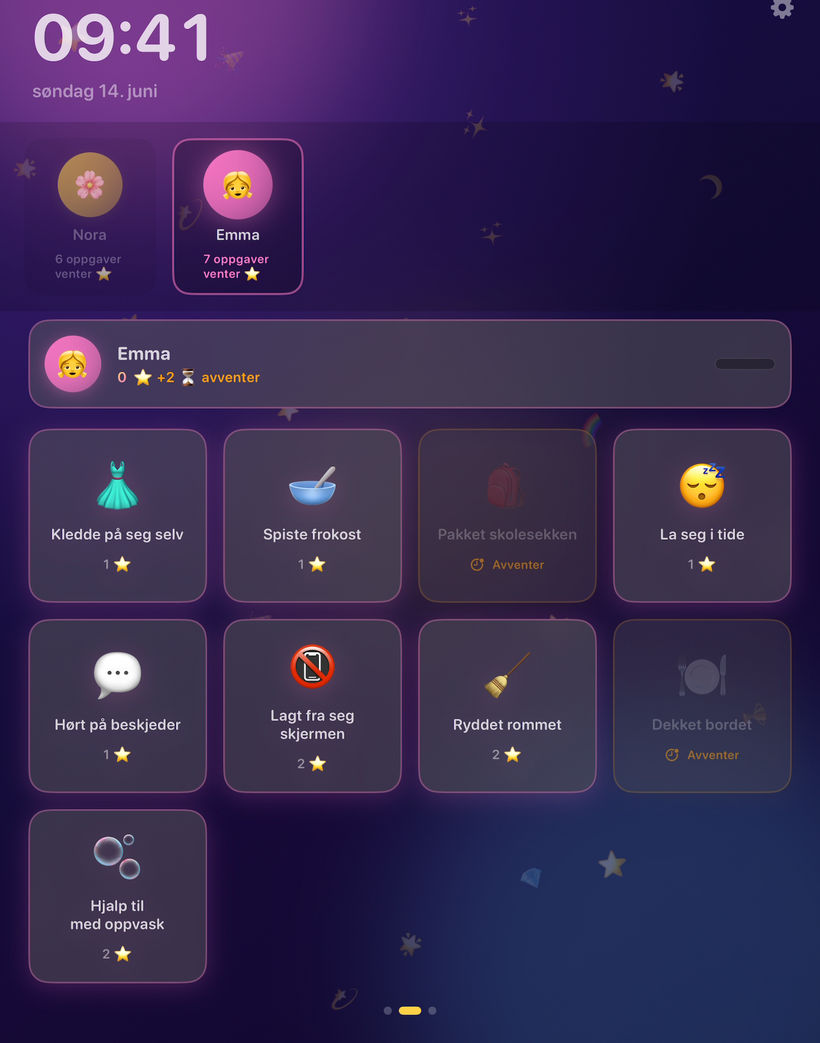
Children are more likely to engage with tasks when three things are clear:
What should I do? Did I do it? Did anyone notice?
A good chore system answers all three.
Visibility helps children know what is expected. Feedback helps them understand whether the task is complete. Celebration helps them feel that their effort matters.
This is where stars can be powerful. A star is simple. It gives immediate feedback. It turns a completed task into visible progress.
For a child, “empty the dishwasher” might feel boring. But “empty the dishwasher and earn stars toward movie night” feels different.
The task is the same. The experience changes.
Parents need approval and flexibility

A chore system should not give children unlimited control. Parents still need to decide whether something is actually done.
That is why approval matters.
In OurFamilyHub, children can check off tasks, but parents can approve them from their own iPhone. This keeps the system fair and prevents the classic problem of “I said I did it” when the task is only half complete.
Parents also need flexibility. Some tasks should be assigned to one child. Others may be shared. Some tasks happen daily, while others only happen once. Some days you may need to approve everything quickly and move on.
A good system should support real family life, not demand that family life fits the system.
How stars create momentum
Stars are small, but they can create momentum.
A child who earns one star is more likely to want the next one. A visible progress bar or reward ladder gives the child a reason to keep going. They can see that small tasks add up to something bigger.
This is especially useful for chores because the reward does not have to be material. Stars can unlock:
- Choosing dinner
- Picking the family movie
- Extra bedtime story
- 30 minutes of screen time
- A trip to the playground
- A small toy
- Pocket money
- A special breakfast
- One-on-one time with a parent
The best reward is not always expensive. Often, it is simply something the child helped choose.
OurFamilyHub turns these ideas into a simple board your kids can actually follow.
Download on the App StoreHow to avoid turning chores into punishment
Chores should not feel like punishment. They are part of belonging to a family.
The tone matters.
If chores are only introduced when a child has done something wrong, they become negative. If chores are connected to contribution, independence and progress, they can become part of everyday life.
A positive chore system should focus on:
- Clear expectations
- Small steps
- Age-appropriate tasks
- Visible progress
- Parent approval
- Encouragement
- Celebration
The goal is not to create a perfect little worker. The goal is to help children learn responsibility in a way that feels manageable.
From chore chart to family board
A modern family needs more than a static list on the fridge.
OurFamilyHub turns routines, chores, stars and rewards into a digital family board. Parents manage tasks from their iPhone. Kids see what is theirs to do. Completed tasks can be approved, and stars help turn effort into progress.
It is still the same good idea behind the old chore chart — make responsibility visible.
It is just built for the way families actually live now.